Roomori
Mobile App

Project Type
Concept Study
Industry
Architecture
Services
Mobile App & AI Design

Overview

Roomori explores room styling through a mobile experience built around a camera-led room canvas with a bottom furniture tray. A room-styling companion for photo-based exploration, visual furniture search and shared design decisions. The proposed journey connects room scan, style variations, furniture shortlist, project board. Four original phone showcases establish the visual direction, while the case study defines the supporting feature set and a proposed Flutter architecture.
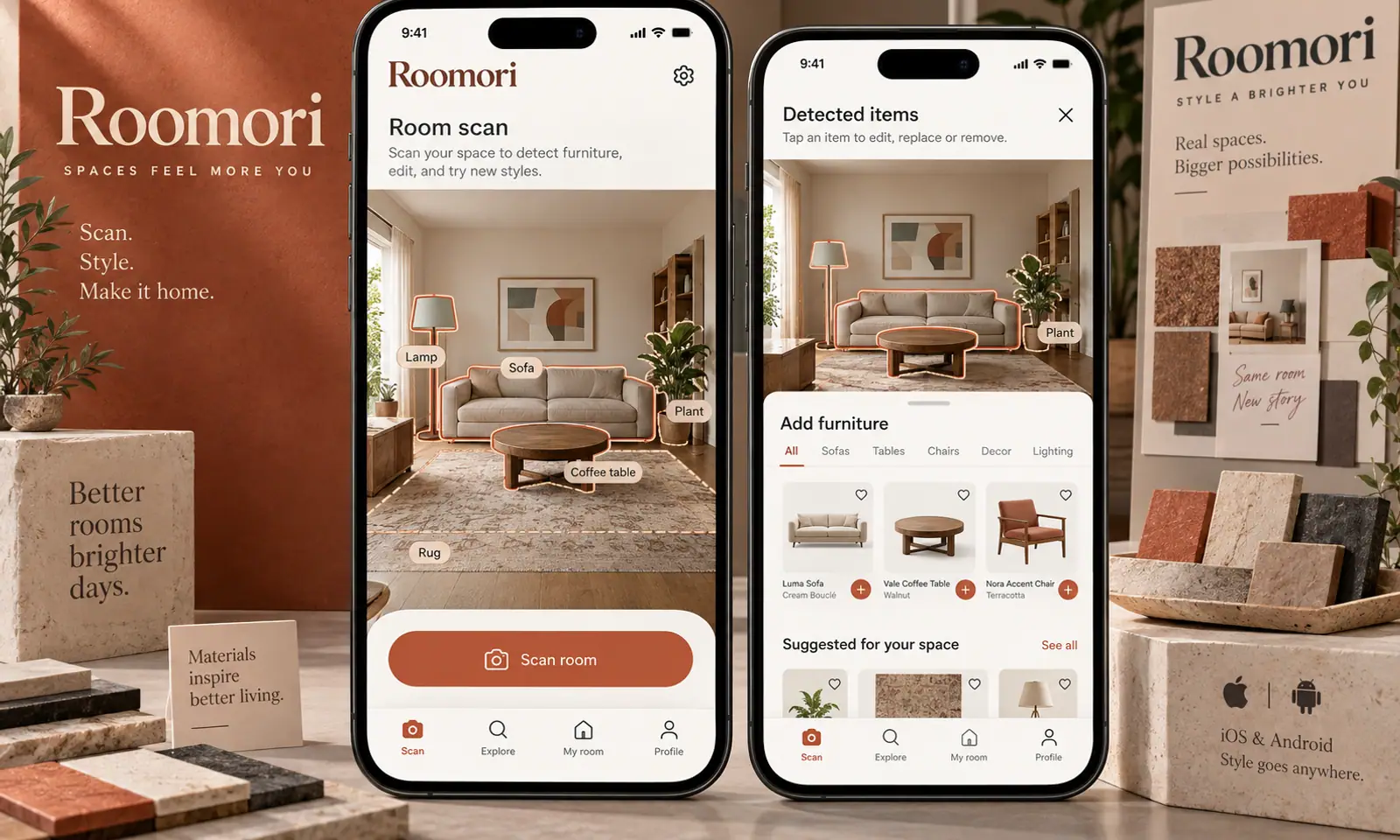
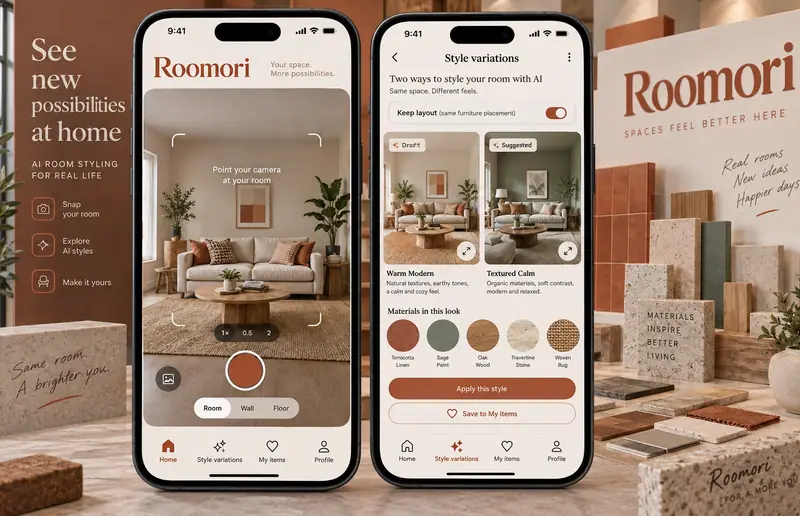
Roomori Mobile App hero

Original mobile interface concepts with fictional content. AI responses illustrate proposed interactions; they are not live model results.

Challenge

Room styling decisions need to connect inspiration with the actual room and a reviewable set of choices. On a phone, the person also needs to capture information quickly, understand where an answer came from and return to the original material without navigating through a dense desktop interface.

  • Keep room scan and style variations connected within a short mobile flow.
  • Make scene understanding correctable when the model misreads the input.
  • Explain visual search through visible references or user-selected preferences.
  • Keep changes, sharing and data retention under explicit user control.

Solution

The design begins with a camera-led room canvas with a bottom furniture tray, using large touch targets, short task sequences and contextual sheets. Draft object labels from an uploaded room photograph for user correction. Explore styling directions while preserving stated layout constraints. The companion views keep drafts, original material and accepted decisions distinct. A terracotta, cream and ink visual system gives this app its own character within the collection.

  • Draft object labels from an uploaded room photograph for user correction.
  • Explore styling directions while preserving stated layout constraints.
  • Find related items within a saved furniture catalog.
  • Use explicitly saved materials and colors to refine later suggestions.

Results

  • 4

    Original mobile
    showcase views

  • 12

    Designed
    feature areas

  • 4

    Proposed AI
    workflows

Let’s CraftingVisual ImpactStart a Project

We Are Available For New Project

Roomori
Mobile App

Project Type
Concept Study
Industry
Architecture
Services
Mobile App & AI Design

Overview

Roomori explores room styling through a mobile experience built around a camera-led room canvas with a bottom furniture tray. A room-styling companion for photo-based exploration, visual furniture search and shared design decisions. The proposed journey connects room scan, style variations, furniture shortlist, project board. Four original phone showcases establish the visual direction, while the case study defines the supporting feature set and a proposed Flutter architecture.

Roomori Mobile App — hero

Original mobile interface concepts with fictional content. AI responses illustrate proposed interactions; they are not live model results.

Challenge

Room styling decisions need to connect inspiration with the actual room and a reviewable set of choices. On a phone, the person also needs to capture information quickly, understand where an answer came from and return to the original material without navigating through a dense desktop interface.

  • Keep room scan and style variations connected within a short mobile flow.
  • Make scene understanding correctable when the model misreads the input.
  • Explain visual search through visible references or user-selected preferences.
  • Keep changes, sharing and data retention under explicit user control.

Solution

The design begins with a camera-led room canvas with a bottom furniture tray, using large touch targets, short task sequences and contextual sheets. Draft object labels from an uploaded room photograph for user correction. Explore styling directions while preserving stated layout constraints. The companion views keep drafts, original material and accepted decisions distinct. A terracotta, cream and ink visual system gives this app its own character within the collection.

  • Draft object labels from an uploaded room photograph for user correction.
  • Explore styling directions while preserving stated layout constraints.
  • Find related items within a saved furniture catalog.
  • Use explicitly saved materials and colors to refine later suggestions.

Results

  • 4

    Original mobile showcase views

  • 12

    Designed feature areas

  • 4

    Proposed AI workflows

Let’s Crafting

Visual Impact

Start a Project